


Why Hard Sets and Intervals Beat Long Workouts

Most mornings start the same way for me: coffee, unload the dishwasher from the night before, then make the bed once the house wakes up.
Ten minutes, tops.
But the payoff is outsized.
An empty dishwasher becomes a convenient hiding place for dirty dishes all day. A made bed makes even a messy room feel acceptable. The house isn’t perfect—but it’s functional.
That’s the Pareto Principle in action: a small investment producing a disproportionate return.
So it got me thinking—what’s the 20% of training that delivers 80% of the results?
Interval Training: The Highest ROI for Aerobic Fitness
Zone 2 training is having a moment—and for good reason. Easy aerobic work builds an endurance foundation.
But if we’re talking efficiency, interval training is the heavy hitter.
A well-known study compared four aerobic training methods, matched for total work:
-
Long slow distance: 45 minutes at ~70% max HR
-
Lactate threshold: ~25 minutes at ~85% max HR
-
15/15 intervals: 15 seconds hard / 15 seconds easy (47 reps)
-
4 × 4 intervals: 4 minutes hard (~95% max HR) with 3 minutes recovery
Despite equal total work, the 4 × 4 protocol produced the greatest improvements in VO₂ max and cardiac function, with the 15/15 intervals close behind.
This doesn’t mean Zone 2 is useless—but if time is limited, intervals deliver the biggest aerobic return per minute invested.

Go Crossover: Ten Minutes That Covers Mobility and Warm-Up
I’m biased—but I’m also practical.
You don’t need hour-long mobility sessions, foam rolling marathons, or yoga classes to meet most joint health needs.
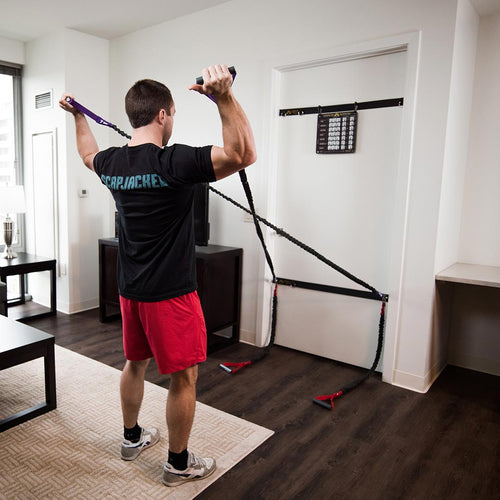
Combining the Crossover Symmetry Shoulder and Hip & Core systems takes about 10 minutes, yet delivers:
-
Improved joint control at end ranges
-
Better usable range of motion
-
A built-in warm-up that prepares you to train
That’s a small daily investment with a big return—and one that stacks neatly into real life.
Hard Sets: Strength Without the Time Sink
If your goal is strength or muscle, total work matters—but returns diminish fast.
Research consistently shows that one hard set taken within 1–2 reps of failure produces the majority of strength and hypertrophy gains. Additional sets help—but the ROI drops quickly.
Think of it like the dishwasher and the bed: you’re not chasing perfection, just a solid baseline.
A minimalist strength template:
-
Lower body: squat (or hinge)
-
Upper body push: bench press (or push-up)
-
Upper body pull: pull-up (or row)
Do:
-
1 warm-up set
-
1 hard working set (where another rep would be questionable)
Have a specific goal (e.g., bigger biceps)? Add 1–2 targeted exercises, again for a single hard set.

The Minimum Effective Dose: A Weekly Blueprint
If time is tight, here’s a baseline that delivers a massive return:
-
Crossover Symmetry: Daily, ~10 minutes
-
Aerobic training: 2×/week
-
4 × 4-minute intervals with 3 minutes recovery (~30 minutes/session)
-
-
Strength training: 3×/week
-
5 exercises
-
1 hard set each (~30 minutes/session)
-
Total time: ~2.5 hours per week
Bonus: This can probably be done without showering.
The goal isn’t peak performance—it’s the minimum effective dose that keeps you strong, fit, and resilient.
If you want to race faster or impress the world with your strength, you’ll need more work. But first, commit to the baseline that delivers the greatest return.