

Why Being “Fit” Isn’t the Same as Being Strong

In a recent newsletter, I handed the mic to a physical therapist on our team and let her vent about some common frustrations she sees in the clinic.
She didn’t hold back.
“You're not strong enough. Sorry! I know you are fit, but you probably aren't strong. Running and cycling don't strengthen your glutes. Rowing doesn't strengthen your rotator cuff. Those are hard exercises, but they aren't strength exercises.”
Brutal. Also… not wrong.
Most of us have been taught to equate effort with strength. If it’s hard and leaves us breathless, it must be making us stronger. But strength is only one part of the equation—and often not the limiting factor.
What Do We Actually Mean by “Strength”?
Strength is a muscle’s ability to produce force.
Think maxing out a leg press or grinding through a heavy curl.
Motor control is how well your nervous system coordinates that force. It’s timing, sequencing, and stability—how muscles work together, not just how strong they are individually.
A barbell squat, a clean, or a single-leg squat may involve similar muscle strength as a leg press, but they demand far more coordination. Without solid motor control, strength doesn’t transfer cleanly to real movement.
Why Strength Alone Doesn’t Always Carry Over
Take my golf swing.
I’d like to believe I have comparable raw muscle strength to many good golfers. But strength isn’t the bottleneck—coordination is.
My swing tends to be top-heavy, driven by arms and shoulders. A skilled golfer produces power through a smooth, sequenced transfer from the ground up. Same muscles. Different organization.
The difference isn’t effort. It’s timing.
How to Build Strength That Actually Transfers
1. Strengthen Full Ranges of Motion
Strength in shortened positions doesn’t always carry over to lengthened ones.
That’s why a tall box step-up feels drastically harder than a short one. You’re asking muscles to produce force in less familiar positions. The good news? Those “weak” positions are trainable.
Gradual exposure builds both strength and control.
2. Challenge Your Nervous System
Exercises that feel awkward are often the most valuable.
That “this feels weird” sensation is your nervous system being forced to reorganize. It’s learning—not failing.
For a great deep dive on this, check out a recent podcast with strength and movement coach Nsima Inyang, who takes a thoughtful approach to motor control and strength transfer.
This doesn’t require new exercises. Sometimes it’s just how you perform them.
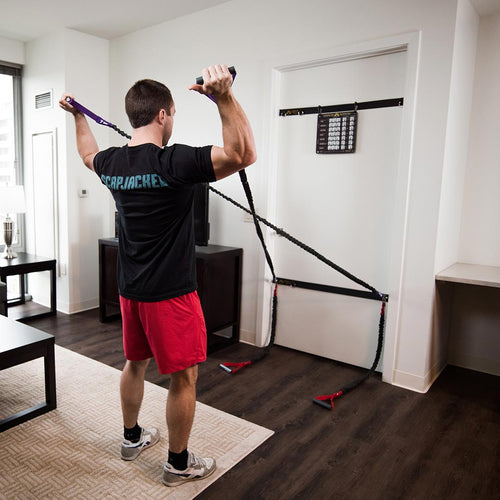
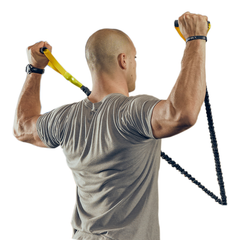
For example, a Crossover Symmetry row can feel entirely different depending on whether you initiate with the elbows or lead with scapular retraction.
Same motion. Different organization.
3. Use External Cues and Props
External feedback speeds up learning faster than internal cues alone.
Touch, bands, or visual targets give the nervous system immediate information. You either hit the position—or you didn’t.
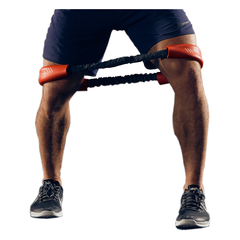
A hand between the shoulder blades during a row, a cue to “squeeze a pencil,” or using the CS Hip Band to reinforce landing mechanics during plyometrics—all create clearer signals than verbal instructions alone.
4. Don’t Skip Isometrics
Isometric holds build awareness and control in specific positions—especially those that feel weak or uncomfortable.
Wall sits, dead bug holds, overhead Y and T holds: these aren’t flashy, but they teach the body how to own a position instead of rushing through it.
5. Stay Varied and Active
Not every movement needs to come from a program.
Climbing, digging, carrying awkward objects, chopping wood, playing unfamiliar sports—these all expand your movement vocabulary.
It’s not about burning calories. It’s about adaptability.
The Bigger Picture
In talking with Kristen, she says she sees it every day.
People say, “I’ve been doing this strength program for months,” but they’re still stuck.
It’s not always that the exercise is wrong, it’s that your body keeps falling back on the same movement pattern.
For some people, getting stronger in general helps a ton. But sometimes, the key to breaking through pain or plateaus is learning to move differently.