

What Makes The Crossover Symmetry Cords Different

The goal for Crossover Symmetry from the start was a training program to improve shoulder performance—and based on the reviews, it does that extremely well.
But beyond the program (which is the pulse of Crossover Symmetry) is the equipment—and that was never an afterthought.
Crossover Symmetry equipment needed to be durable, lightweight, and portable, so resistance bands were the natural solution. But contrary to popular belief, “cheap bands on Amazon” are not the same.
Here’s what makes the investment in Crossover Cords worth every penny…
Dip Your Rubber
A defining feature of bands is that resistance changes as the rubber stretches.
That’s great for helping you get your first pull-up—or if you’re building a watermelon launcher—but it’s a problem for movements that train relatively weak positions, like our Victory or 90/90 exercises.
But changing how the rubber is made can fix this problem.
The most inexpensive option is thermoplastic rubber (TPR). TPR is a blend of rubber and plastic, and using a plastic filler makes it cheaper. However, it’s not as “stretchy.”
You’ll notice the start of the movement is at one resistance level, and at the end (where you’re usually at your weakest point), the tension is significantly greater.
Extruded rubber is the next option. This produces a band made of 100% rubber—like squeezing toothpaste out of a tube. It’s more elastic than rubber/plastic blends, but still not as good as the third option: dipped rubber tubing.
Dipped rubber is made like a candle, where one layer of rubber forms over another. As the band builds, you get gradually thicker layers, resulting in a smoother, more consistent resistance.
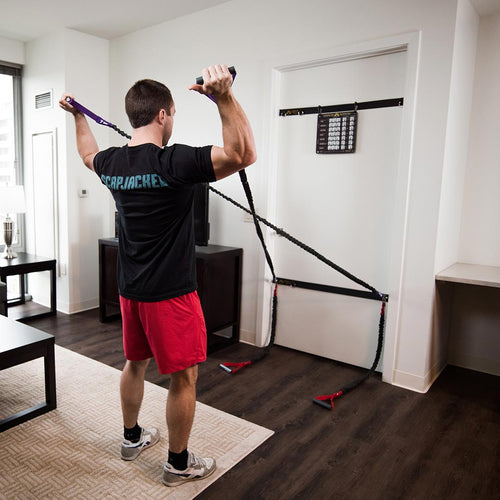
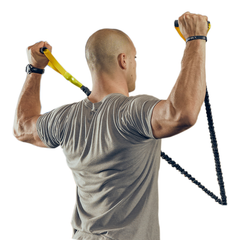
Crossover Cords use dipped rubber tubing, giving you a smooth, even pull that’s ideal for rehabilitation and strengthening weak positions.

Protect What Your Mama Gave You
I’ve argued before that all unsleeved resistance bands should be banned from commercial training facilities—or at the very least, carry a clear safety warning.
But many people are still willing to risk a slingshot to the face to save a few bucks.
Here’s why that’s a problem.
A 2021 study published in the American Journal of Emergency Medicine reported 11 eye injuries in a single clinic over just 7 months caused by resistance bands. Many were severe, and some resulted in permanent damage.
Now expand that across all clinics, over a full year—and you’re looking at thousands of injuries.
And that doesn’t even include the “near misses” that hit everything but the eye.
The study recommended wearing eye protection when using resistance bands. But a better solution is a protective sleeve that contains the band if it breaks.
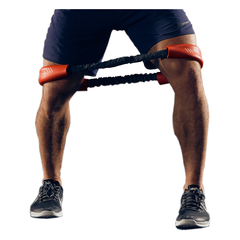
The sleeve also extends the life of the band by protecting it from UV exposure, abrasions, overstretching, and general wear and tear.
The bottom line is that this isn’t just about durability—it’s about safety.
Something to Hold Onto
Finally, you should have something solid to hold when performing resistance band exercises.
I’ve written about the benefits of handles before, but the key point is this:
Gripping something firmly creates a natural activation of the muscles in your arm, shoulder, and back before the movement even starts.
On the flip side, a weak grip with poor wrist control often leads to compensations at the elbow, shoulder, or even the spine.
If you want to be stronger immediately—start with your grip.
Crossover Cords are designed with upgraded handles to help you do exactly that.
Not All Bands Are Created Equal
There are plenty of benefits to resistance bands—but as you can see, they are not all made the same.
That’s why we build our equipment to match the quality of the training. And to protect your investment, every set comes with a 2-year guarantee.