

Muscles Adapt Faster Than Your Tendons (and Why That Matters as You Age)

In this article, we coved why tendons hurt, why they’re slow to heal, and how to get them back on track.
But as the saying goes, an ounce of prevention is worth a pound of cure.
This week, the focus shifts to keeping tendons resilient in the first place.
That message matters more as we age. Tendons undergo structural, functional, and metabolic changes over time that reduce their ability to tolerate load and recover between sessions. Unfortunately, tendons are also hard to study in humans.
Different tendons experience very different demands—what’s ideal for the Achilles may not apply to the rotator cuff—so the research isn’t always clean or definitive.
Still, some principles are consistent enough that we can train intelligently, even without a perfect randomized controlled trial to point the way.
Load Management & Recovery
I agree with the idea that age is just a mindset. We can—and should—keep pursuing adventure and physical challenges as we get older.
But tendon biology doesn’t care how motivated we are.
Muscle adapts quickly. Tendon and cartilage adapt slowly.

This mismatch matters. As muscle strength improves faster than tendon capacity, the risk of overload rises—especially if training loads progress too quickly.
That’s why linear progression becomes more important, not less, with age. This doesn’t mean limiting yourself. It means respecting the timeline of tissue adaptation:
-
More gradual increases in load
-
More frequent low-impact cross-training
-
Strategic active recovery days
You’re training your entire body, not just your muscles.
Tempo & Tension
Resistance training remains one of the most effective tools for tendon health—particularly when it includes eccentric and isometric loading.
That means controlled tempo, full ranges of motion (at least some of the time), and intentional tension.
It also means doing a little work for body parts you may not care much about aesthetically.
You might be perfectly happy with your calves—but slow, controlled calf raises a few days per week can pay big dividends for Achilles health. The same logic applies to the shoulders, hips, and knees.
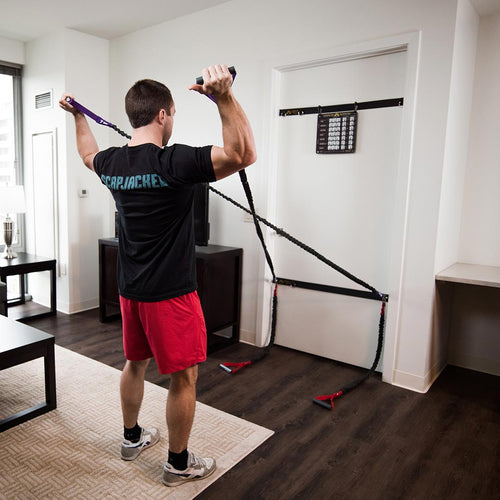
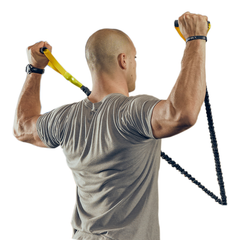
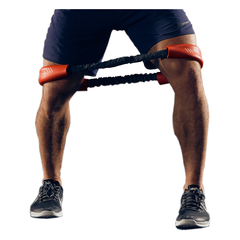
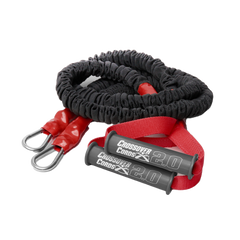
This is one reason Crossover Symmetry has translated so well to CrossFit athletes.
The principle of “increased work capacity across broad time and modal domains” builds muscle effectively—but fast, dynamic lifts don’t always provide enough tempo or sustained tension to keep tendons adapting alongside strength.
A daily dose of Crossover Symmetry fills that gap—as long as the movements stay controlled.
Plyometrics
As we age, our daily lives naturally lose explosive movement. We stop sprinting, jumping, and rebounding off the ground.
That’s not all bad—but tendons thrive on rapid loading and unloading. Plyometric activities improve tendon stiffness and elastic energy storage, both of which are essential for efficient movement.
Plyometrics don’t have to mean box jumps and hurdles. Simple skips, hops, and bounds go a long way.
Matt McInnes Watson—aka The Plyo Guy—does excellent work here, and Crossover Symmetry includes accessible plyometric options as well.
Plyos are appropriate at any age—but only if they’re progressed patiently. If you’re feeling inspired, skip the Christian McCaffrey highlight reel and start with the basics.
The Long Game
Tendon health isn’t just about avoiding pain or injury. It’s about preserving your ability to move well—and powerfully—for decades.
The foundation is simple:
-
Stay active
-
Load intelligently
-
Progress gradually
Resistance training, targeted tendon work, and appropriately scaled plyometrics keep tendons strong and elastic—but only when balanced with enough recovery time for real tissue adaptation to occur.
Play the long game. Your future joints will thank you.


)