

If You Want More Strength, Stop Lifting Slow (Sometimes)

As we've covered over the last few weeks, manipulating the tempo of the lift can be just as impactful as the number of sets, reps, and rest when pursuing greater muscle strength and hypertrophy.
As part of the tempo discussion, we covered the formula:
Eccentric – Pause – Concentric – Pause
These numbers dictate the number of seconds to spend on each phase of a lift.
For example, 2/0/3/0 would mean a 2-second lower and 3-second lift, with no pause between the lift and lower.
Up to this point, we've highlighted the lowering and pause portions of the lift. Today, we’ll wrap it up with the all-important lifting phase—the concentric.
Understanding the Concentric Phase
The concentric phase of a lift is when the muscle contracts and shortens—such as the upward movement in a squat or bench press, or the curl portion of a biceps curl.
Traditionally, this phase is executed as explosively as possible, especially in strength training, to maximize force production. In tempo notation, this is often represented with an “X”, meaning “move as explosively as possible.”
However, adjusting the duration of this phase can lead to different training outcomes—primarily affecting muscle hypertrophy and maximal strength development.
Strength: Move It With Intent
When training for strength, the primary goal is to increase the maximum force a muscle can produce.
Research suggests that performing the concentric phase explosively—regardless of the load—can enhance neuromuscular adaptations and improve strength gains.
This works because explosive intent:
-
Improves motor unit recruitment
-
Increases rate of force development
-
Trains the nervous system to fire faster and more efficiently
If maximal strength is the goal, lifting with speed (even if the bar moves slower under heavy load) is key.
Hypertrophy: Extend the Tension
Muscle hypertrophy, or growth, is maximized under conditions of increased muscular tension and time under tension (TUT).
Slowing down the concentric phase can:
-
Prolong time under tension
-
Increase metabolic stress
-
Enhance mechanical tension
All three are major drivers of muscle growth.
By controlling lift speed and increasing the duration of the concentric phase, lifters can create more fatigue and mechanical stress within the muscle fibers—two signals associated with hypertrophy.
The Balancing Act
For most athletes and lifters, a blended approach makes the most sense.
You can:
-
Use explosive concentric intent in strength-focused sessions
-
Use slower, controlled concentrics in hypertrophy-focused sessions
-
Periodize within a week or even within the same workout
This allows you to develop both force production and muscle size without being boxed into one method.
Practical Application
Implementing this into your training can be straightforward:
Strength Sessions
-
Heavier loads
-
Explosive concentric intent
-
Longer rest intervals
Hypertrophy Sessions
-
Moderate loads
-
Slower, controlled concentric phase
-
Slightly shorter rest intervals
One practical advantage of tempo manipulation is that you can generate meaningful fatigue with lighter loads.
That’s helpful when:
-
You're in a hotel gym with 10 lb dumbbells
-
You're at home with only bodyweight
-
Equipment options are limited
You can still create a productive training stimulus.
Slow or Fast with Crossover Symmetry?
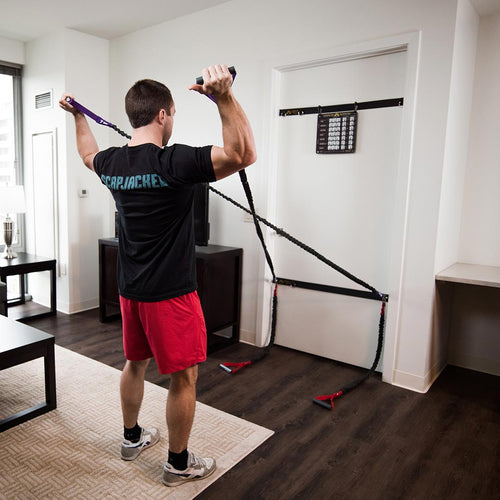
Tempo absolutely applies to Crossover Symmetry.
Initially, I recommend focusing on controlled movements with lighter resistance bands to increase time under tension and reinforce quality movement.
As you adapt:
-
Increase contraction speed
-
Add more explosive intent
-
Progress toward higher output
For example:
-
The Activation+ program includes faster, more powerful movement patterns
-
Portions of the Strength program incorporate explosive movements (see: ATYT)
Eventually, tempo becomes a day-to-day adjustment based on how you’re feeling and what you're training for.
Tempo Matters
Adjusting lift timing gives you a powerful lever to manipulate training outcomes.
Whether your goal is strength, hypertrophy, or both, tempo allows you to fine-tune your stimulus without necessarily changing equipment or total volume.
It’s a subtle shift with meaningful impact.


)