

How to Use Isometrics to Reduce Pain and Build Strength

Last week, we introduced some nuance to your weightlifting plan by adding tempo to your lifts.
We covered the terminology of:
eccentric – pause – concentric – pause
Adding tempo to your prescription helps define the intent and outcome of each rep. Now, let’s isolate one variable in that recipe: the pause under tension—better known as the isometric.
What Is an Isometric?
An isometric contraction produces force without joint movement.
Holding a pair of dumbbells with your elbows flexed. Sitting in the bottom of a squat. Pausing at the sticking point of a press.
The muscle is working. The joint just isn’t moving.
Isometrics are common in physical therapy, but they’re often ignored in the gym because they’re less flashy than heavy squats, presses, curls, and sweat-soaked conditioning.
That’s a mistake.
When used correctly, isometrics can reduce pain, improve joint stability, and even enhance performance.
1. Pain Relief Without Provoking the Joint
One of the biggest advantages of isometrics is that they generate high muscular tension with minimal joint motion. That makes them extremely useful in the early phases of rehab when movement itself is painful.
Historically, people attributed their benefits to increased blood flow. But more recent evidence suggests the pain-relieving effect may be driven more by central mechanisms—specifically reduced cortical inhibition and altered pain perception (Rio et al., 2015).
In other words, isometrics don’t just “pump blood.” They can calm down the nervous system.
Research has shown isometric loading can reduce pain in:
-
Patellar tendinopathy
-
Achilles tendinopathy
-
Lateral elbow tendinopathy
-
Rotator cuff–related shoulder pain
A commonly studied protocol looks like this:
-
5 sets
-
30–45 second holds
-
At approximately 70% of maximal voluntary contraction (MVC)
That’s enough intensity to create high tendon tension without aggravating the joint.
Practical Shoulder Example
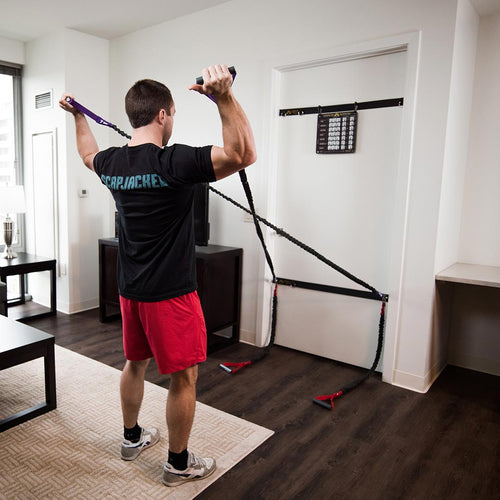
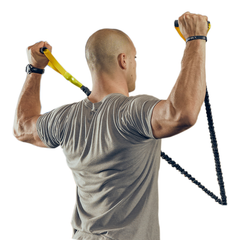
When using Crossover Symmetry for shoulder pain, certain movements may be irritating—like the overhead Victory or 90/90 position.
Instead of removing the pattern entirely, you can modify it to an isometric:
-
Move close to the attachment so there’s minimal band tension.
-
Get into the final shoulder position.
-
Slowly step backward to add light tension.
-
Hold for 10–20 seconds (or longer as tolerated).
-
Reset and repeat.
This allows you to load the joint position without repeatedly moving through a painful arc.
Over time, that builds tolerance so you can return to full-range movement.
2. Stability: Strength Is Position-Specific
Joint stability is highly dependent on position.
Isometrics allow you to spend time strengthening specific joint angles. That matters because strength adaptations are highly angle-specific—meaning you get strongest where you train.
If you want to improve your squat, spending time in the bottom position makes sense.
Start with a goblet squat and hold the bottom. But don’t just “hang out” there.
Create tension:
-
Screw your feet into the floor
-
Engage the hips
-
Brace the trunk
-
Stay tall
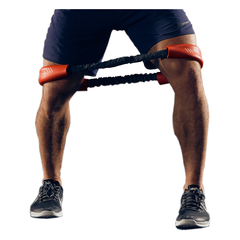
Using a hip and core band can reinforce proper alignment and external rotation torque.
This type of positional strength work builds active stability—not passive flexibility.
3. Potentiation: Priming the System for Performance
Isometrics aren’t just for rehab. They can also enhance performance.
A high-intensity isometric contraction before a lift can create what strength coaches call:
-
Post-Activation Potentiation (PAP)
-
Or more accurately in many cases, Post-Activation Performance Enhancement (PAPE)
Maximal contractions increase motor unit recruitment and temporarily enhance the muscle’s ability to produce force. At the cellular level, elevated calcium availability improves actin-myosin interaction. At the neural level, the system becomes more “excitable.”
Translation: you’re primed to move something heavy.
It’s one of the core features of our ArmCare System for baseball players. Pre-throwing isometrics help kick-start the arm and prepare it for high-velocity output.
You can apply the same principle in the weight room:
-
Use a heavier band than normal for your activation work
-
Perform 1–2 reps
-
Hold the final contraction for at least 5 seconds
If the resistance is too high, use the walk-back method or assist with the opposite arm.
Done properly, you’ll feel more stable and more powerful on the lifts that follow.
4. Performance Carryover: Attack Your Sticking Points
Isometric strength gains are highly specific to joint angle.
That’s a feature, not a flaw.
Long-length isometrics—like holding just above the chest in a bench press or slightly above parallel in a squat—can increase force production at common sticking points.
If you always fail at the same position in a lift, spending time producing force at that angle can help you break through.
Less motion. More intention. Better transfer.
Isometrics for Health and Performance
Isometrics are often viewed as a temporary stop on the road back to “real training.”
But that mindset misses their full value.
- They reduce pain.
- They improve positional strength.
- They enhance neural drive.
- They reinforce stability.
And when programmed intentionally, they can improve both durability and performance over the long haul.
The pause is a tool and not just a placeholder in your tempo.