

How Eccentrics Build Strength and Resilience

As discussed in the previous newsletter, an equation like the one below dictates how fast or slow the weight should be lifted.
4-1-X-1
This week, we will focus on the formula's first digit, called the eccentric.
The eccentric phase describes the lowering phase of the lift, where the muscle is lengthening while under tension.
The biceps curl is an easy movement to picture this action. As you lift the weight towards your shoulder, that's the concentric phase—the muscle shortens as it contracts.
As you control the weight back down, that's the eccentric phase.
The eccentric phase shouldn't be overlooked as a passive return to the starting position. Instead, it's an opportunity to promote more muscle activation, growth, and a varied training stimulus.
Here are a few benefits of being more intentional with this part of your lift.
1. Neuromuscular Gains
As readers of The Movement, I'm sure you're aware that training stimulates muscular and neurological adaptations that improve our capacity to work.
Eccentric exercises require a significant amount of neurological control that benefits our ability to contract more motor units and higher threshold fibers.
2. Tendon Health
Physical therapists often use eccentrics to heal tendon pain and reduce pain in athletes. However, eccentrics shouldn't be isolated to rehab situations, because both healthy and injured tendons love tension.
The fibers of a healthy tendon are long and run together like the wires of a steel cable. The mechanical tension of lifting things promotes this structure. In unhealthy tendons, the structure looks matted and woven.
3. Muscle Length
Another important benefit of eccentric exercise is that it promotes an increase in muscle fiber length. If flexibility is a priority for your routine, try adding slow, lengthening contractions instead of long stretch sessions.
Adding Eccentrics
For the hardcore, you can try adding eccentric overload training to your program. This requires using a heavier load than what you can lift, lowering it slowly, and then using assistance to get it back up.
For example, you load more than your 1RM on the bench press, control the descent to your chest, and then have spotters help you get it back up.
This would make for a heavy-hitting press day, although it's probably more complex than necessary for most of us.
Still, we all need the challenge of some eccentric exercises. Here's where I see them being most necessary:
1. Controlled Lowers
It's not as intense as the eccentric overload technique, but I typically control all my core lifts (squats, deadlifts, presses, pullups, etc.) for 3 seconds.
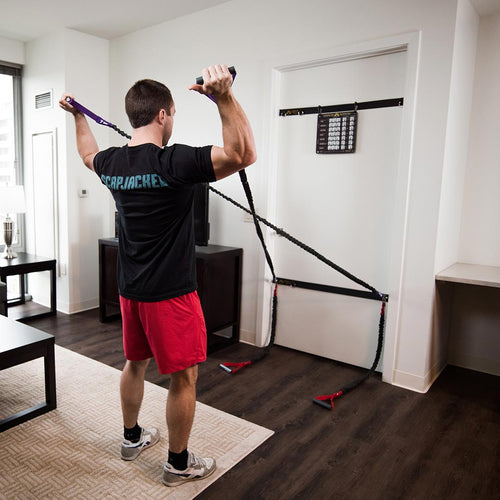
Overall, I lift less weight but get more out of my program. And, of course, keep the tension on when doing Crossover Symmetry!
2. Fast Eccentrics
We typically only think of eccentrics as super-slow lowering, but sometimes, we have to slow our fast-moving body quickly.
For example, baseball players place a massive eccentric load on their posterior shoulder to decelerate their fast-moving arm when pitching.
But in everyday life, the fast eccentric shows up often when hopping off something or catching ourselves when we stumble. In these moments, our legs have to quickly catch our quickly descending body before we crumble into a heap.
I add fast-eccentrics alongside my plyometric training.
This includes sets of pause-squat-jumps and drops from a small ledge and sticking the landing in my dynamic warm-ups.
The Hip & Core Plyometric Program includes some of this as well.
3. Tendon Specific Training
As a runner, my calves and hamstrings take a beating. To combat this, I've added several sets of calf raises and Nordic hamstring curls to my leg days.
In both these movements, I focus on the eccentric portion to promote strong tendons for the legs that will carry me.
Don't Cheat on The Eccentric
The eccentric phase is the unsung hero, quietly orchestrating muscle growth, injury resilience, and overall performance.
Next time you hit the gym, embrace the eccentric, and unlock the full potential of your workouts.